October at a Glance – Cowichan Valley Real Estate
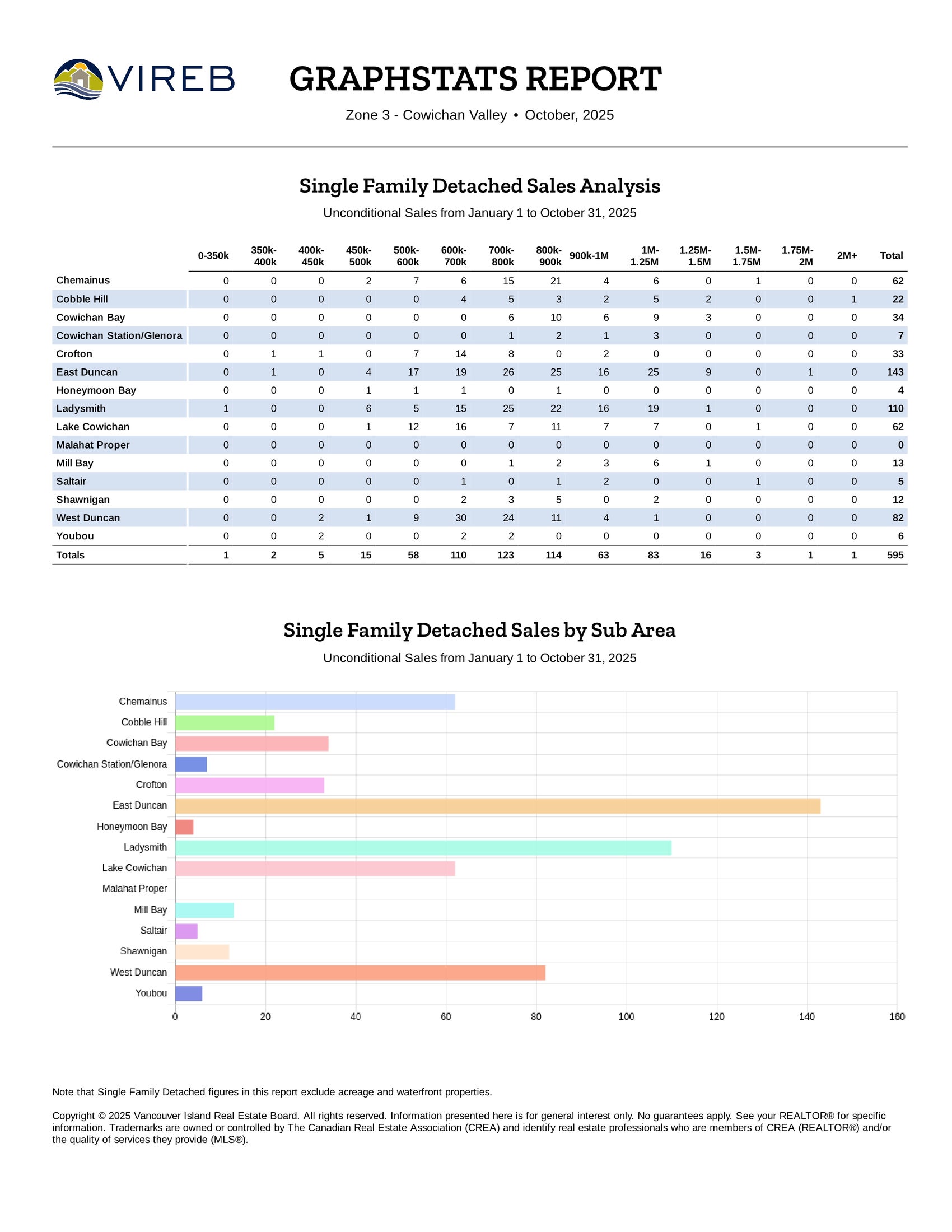
The fall real estate season brought a cooler pace to the Cowichan Valley, but home values continue to hold strong. With fewer new listings and steady demand, the average single-family home sold for just over $817,000, and properties took about 50 days to sell. It’s a sign of a balanced market heading into the final months of the year. Current trends suggest the spring 2026 market may show renewed momentum, supported by steady demand and limited housing supply. Unless a significant increase in listings occurs, prices are likely to remain stable or edge upward through early spring.
October Market Update: Single-Family Homes in the South Island
COWICHAN VALLEY
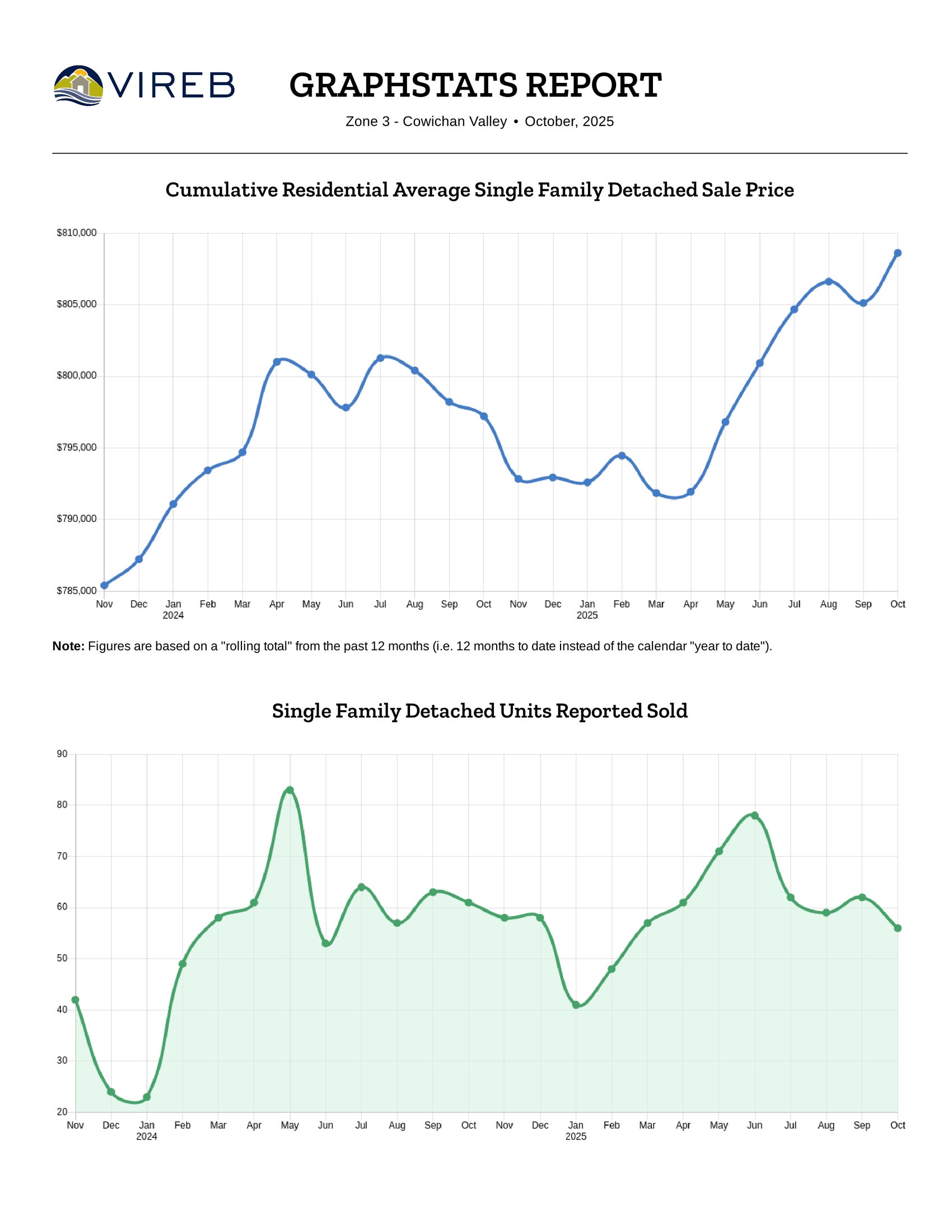
Summary: As of October 2025, the average sale price for single-family homes was $817,844, with a sell-to-list ratio of just under 97.3%.
Sales Activity: A total of 56 single-family homes were sold in the Cowichan Valley during October 2025, marking a decrease from 61 homes sold in October 2024 and also down from 63 homes in September 2025.
Listings & Inventory: The market saw 86 new single-family home listings in October, a significant drop of about 8% compared to 96 listings in October of last year. As of the end of the month, 238 homes were actively listed, down considerably from 296 homes available at the same time last year.
Pricing Trends:
• The average sale price in October 2025 was $817,844, reflecting an upward change from October 2024’s average of $776,168.
• Compared to September 2025’s average of $781,769, prices have strengthened slightly.
• For the 12-month period ending in October 2025, the median sale price stood at $786,000.
Annual Performance: Over the past 12 months, 711 single-family homes were sold, which represents a 11.4% incline compared to the 638 sales in the same period ending in October 2024. The average selling price for the year is up by 1.4%.
Market Supply & Days on Market:
• The supply of homes increased to 5.9 months in October, up from 5.5 months in October 2024..
• Homes sold in October 2025 took an average of 50 days to sell, compared to 53 days in October last year.
This summary highlights the key market trends and performance for single-family homes in the Cowichan Valley, helping homeowners and buyers stay informed about the latest developments. Feel free to reach out for further details or if you need personalized advice!

Condo & Townhome Market Update
Condominiums
In October, the condominium market saw a slight decrease with 10 units sold, compared to 12 in September. Sales are also down from the 12 units sold in October of last year. The average price for condo apartments over the past 12 months ending in October 2025 rose to $355,868 – about 2% increase from last year's average of $349,065.
Townhomes
The townhome market experienced an downward trend, with 11 sales in October, an decrease from both the 19 units sold in September and 17 in October 2024 (a 35% year-over-year decrease). The average price for townhomes over the past 12 months ending in October reached $564,007, down just 0.5% from $566,955 during the same period last year.
VICTORIA
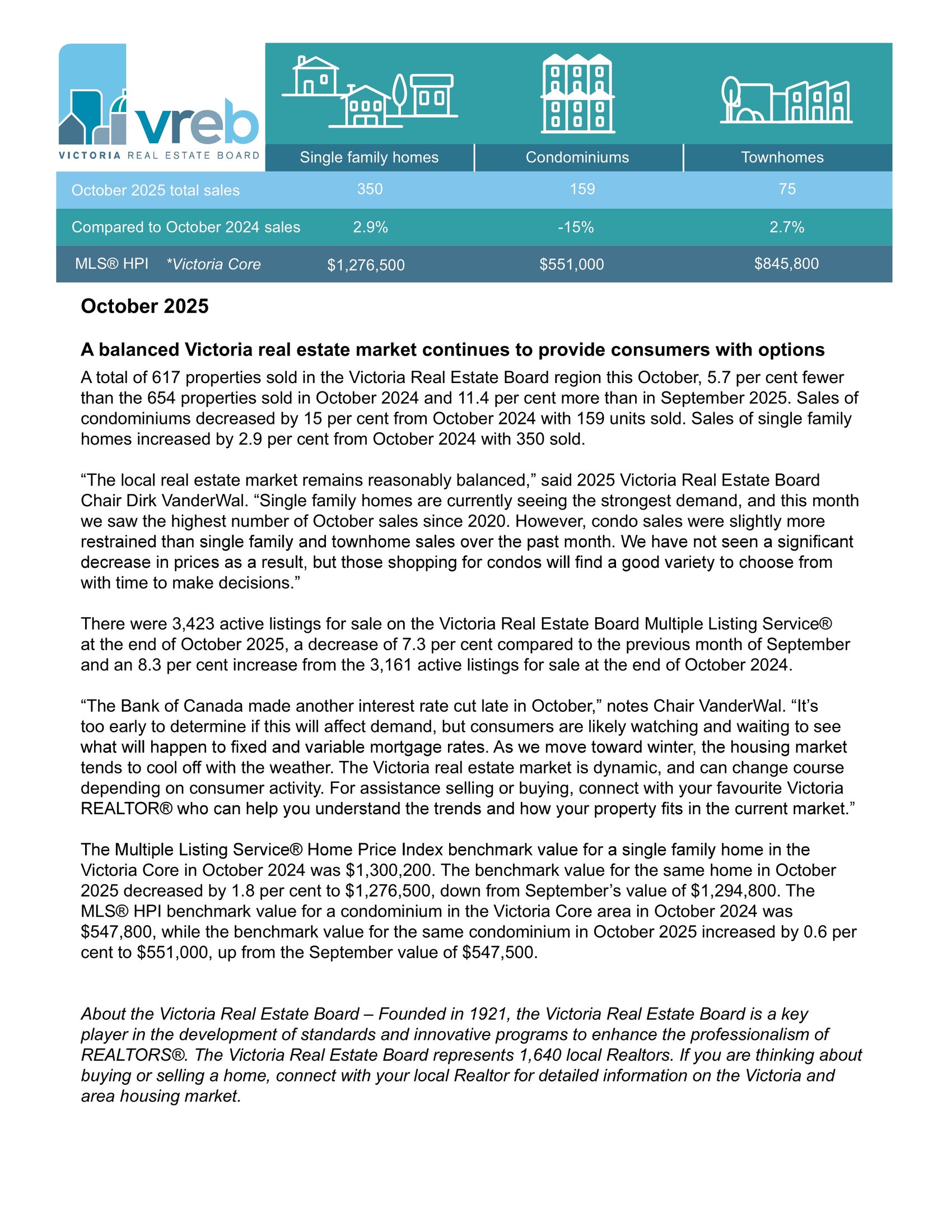
Summary: In October 2025, the benchmark price for single-family homes in the Victoria Core reached $1,276,500, reflecting a 2.9% year-over-year increase.
Cowichan Tribes vs Canada Court Decision
Cowichan Tribes, and fee simple land: This case marks a milestone in Indigenous land rights, setting a precedent for reconciling Aboriginal title with existing property laws. It also signals potential changes for landowners, governments, and First Nations navigating overlapping claims to land and resources.
Key findings of the ruling
Key findings of the ruling
• Aboriginal title: The court recognized the Cowichan Tribes' Aboriginal title to the historic village site of Tl’uqtinus and some submerged lands.
• Fraser River fishing right: An Aboriginal right to fish for food in the south arm of the Fraser River was also recognized. • Invalid fee simple title: The court found that many of the fee simple titles and interests held by Canada and the City of Richmond were defective and invalid because they infringed on the Cowichan's Aboriginal title.
• Transition period: The declaration of title was suspended for 18 months to allow for an orderly transition of the land to the Cowichan Tribes.
The 2025 B.C. Supreme Court decision in Cowichan Tribes v. Canada has made history—recognizing Aboriginal title on privately held land and affirming the Cowichan’s right to fish in the Fraser River.
The court ruled that the provincial government's grants of fee simple title to the land were invalid and suspended the declaration for 18 months to allow the parties to transition the land. This landmark decision is significant because it's the first time a court has recognized Aboriginal title on land already held in fee simple.
What this means
The 2025 B.C. Supreme Court decision in Cowichan Tribes v. Canada has made history—recognizing Aboriginal title on privately held land and affirming the Cowichan’s right to fish in the Fraser River.
The court ruled that the provincial government's grants of fee simple title to the land were invalid and suspended the declaration for 18 months to allow the parties to transition the land. This landmark decision is significant because it's the first time a court has recognized Aboriginal title on land already held in fee simple.
What this means
- A historic victory for the Cowichan people: The decision marks a significant legal victory after 11 years of legal proceedings and decades of struggle for recognition of their ancestral lands and rights.
- Reconciling Aboriginal and private property rights: The ruling sets a precedent for how to reconcile Aboriginal title with existing private property ownership in British Columbia and potentially across Canada.
- Impact on fee simple landowners: The decision has implications for private landowners in the area, as it establishes that fee simple ownership is not absolute when it conflicts with constitutionally protected Aboriginal rights.
- Ongoing developments: The case's outcome is subject to ongoing appeals, and the transition of the land is a process that will likely involve negotiations between the Cowichan Tribes, the government, and potentially the landowners.

Interest Rate Cut October 2025
The Bank of Canada cut its policy interest rate by 25 basis points to 2.25% on October 29, 2025, citing weakness in the economy caused by trade disruptions and a cooling labor market. The cut was anticipated by economists and brings the rate to the lower end of the bank's neutral range. The bank indicated that while it will support economic growth, it is focused on keeping inflation controlled, especially given that underlying inflation remains sticky.
Key details of the rate cut
Market reaction and implications
Key details of the rate cut
- New rate: The target for the overnight rate was lowered by 25 basis points to 2.25%.
- Economic reasons: The bank cited the negative effects of US trade actions on economic growth and inflation, which have become "somewhat clearer". The labor market is also showing signs of strain.
- Monetary policy: The cut brings the policy rate to the lower end of the bank's neutral range of 2.25% to 3.25%. Future cuts beyond this level would be considered stimulative.
- Inflation: The bank expects inflation to moderate, but notes that underlying inflation remains around 2.5%, and that it is watching core inflation measures closely.
- Outlook: The bank is proceeding cautiously, monitoring trade developments, business investment, employment, and consumer spending.
Market reaction and implications
- Anticipated move: The rate cut was widely expected by economists.
- Prime rate: The prime lending rate for consumers is expected to fall to 4.45% following this cut.
- Mortgages: Variable mortgage rates are also expected to drop, with the lowest five-year variable term decreasing by about 30 basis points to 3.45%.