February 2026 Market Update: Single-Family Homes in the South Island
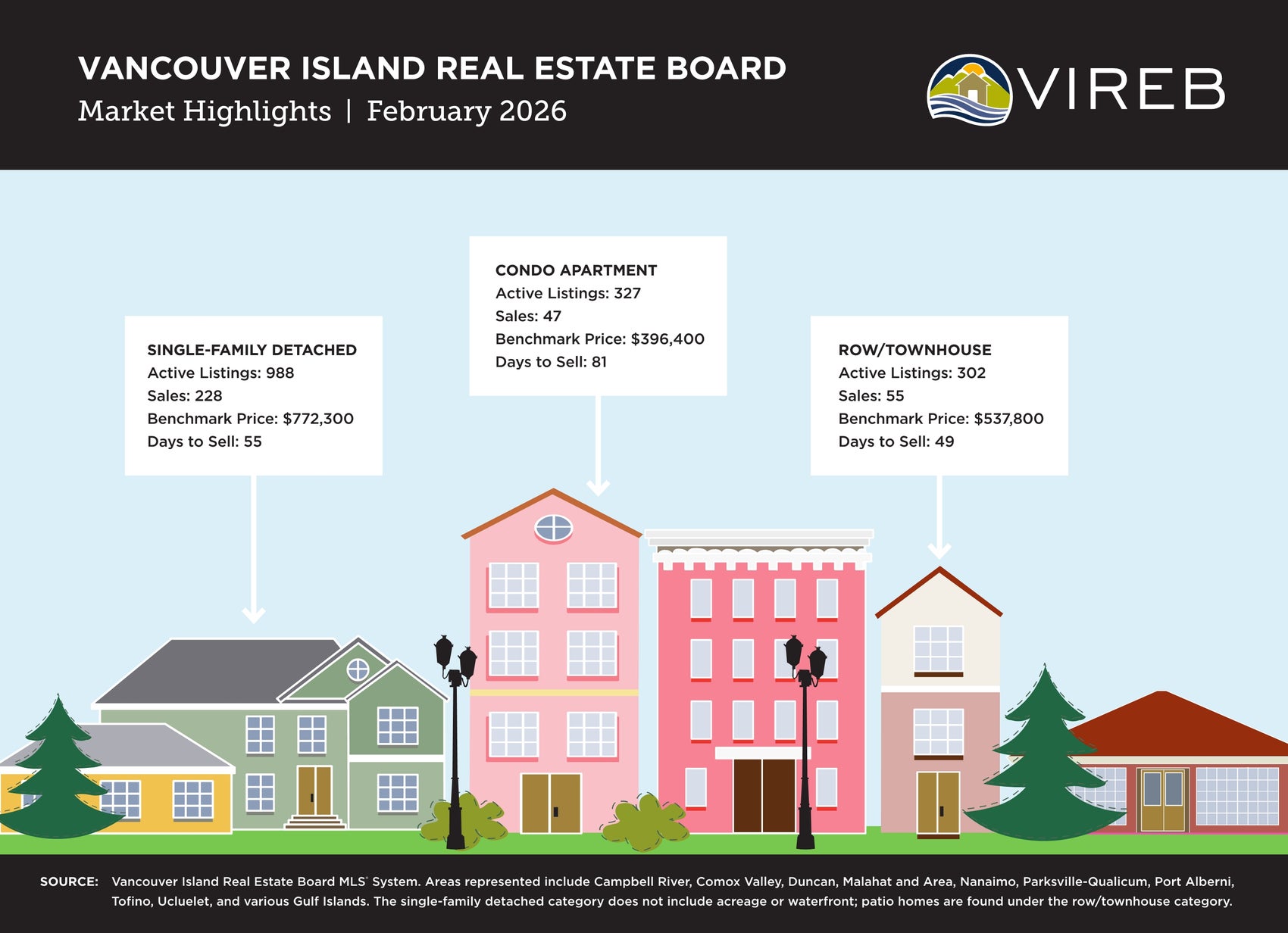
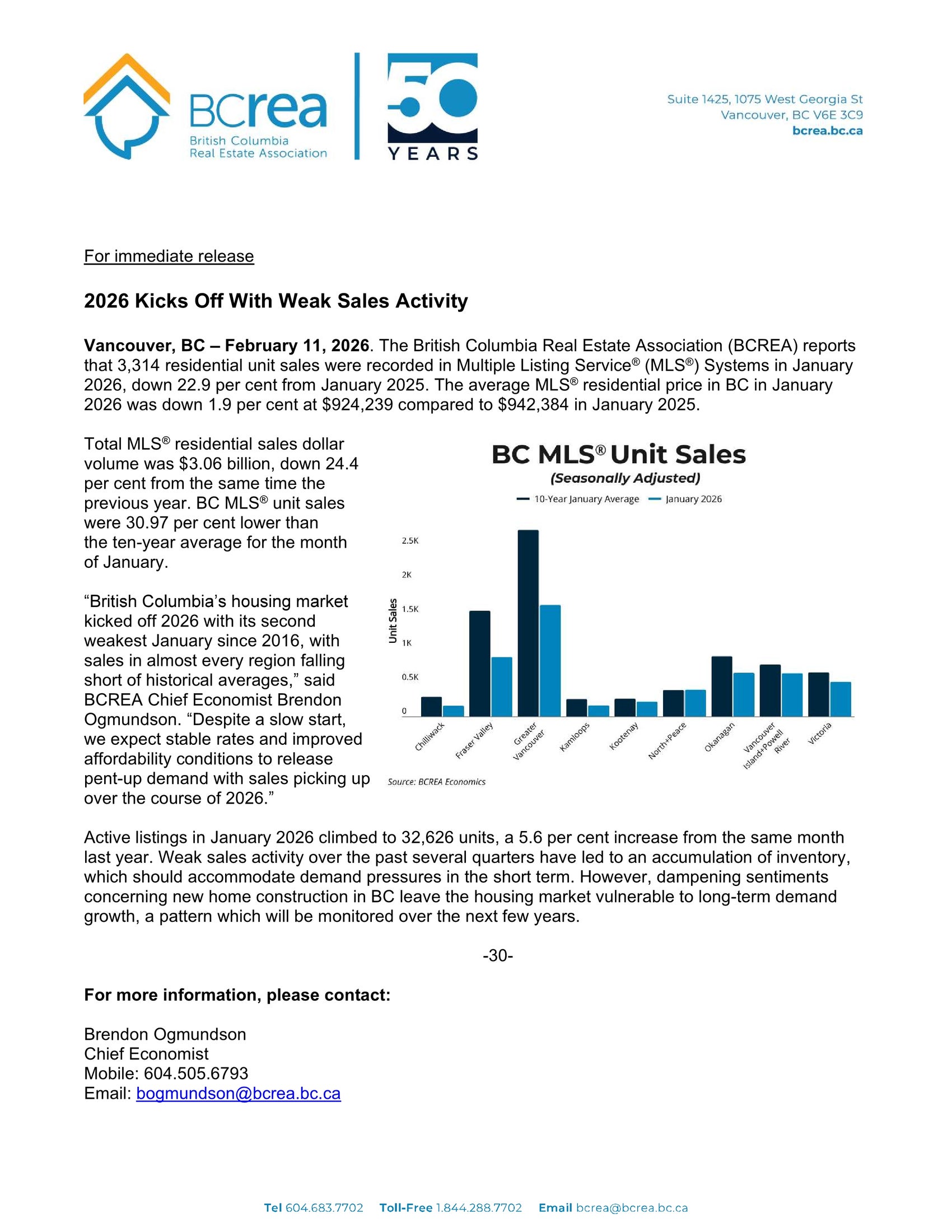
As we move into spring, the Vancouver Island Real Estate Board (VIREB) market is showing more activity compared to the start of 2025. February saw a rebound in single-family home sales after a slower January, suggesting that buyers are returning and preparing for the spring market. Overall conditions remain relatively balanced, although inventory levels will continue to influence pricing trends.
While the first week of March felt somewhat quiet, activity has noticeably picked up. I’ve personally been receiving a significant increase in inquiries, and many of my colleagues across the region are reporting the same. Based on patterns from the past few years, mid-April is often when the market really begins to gain momentum, so the coming weeks will be important to watch.
COWICHAN VALLEY
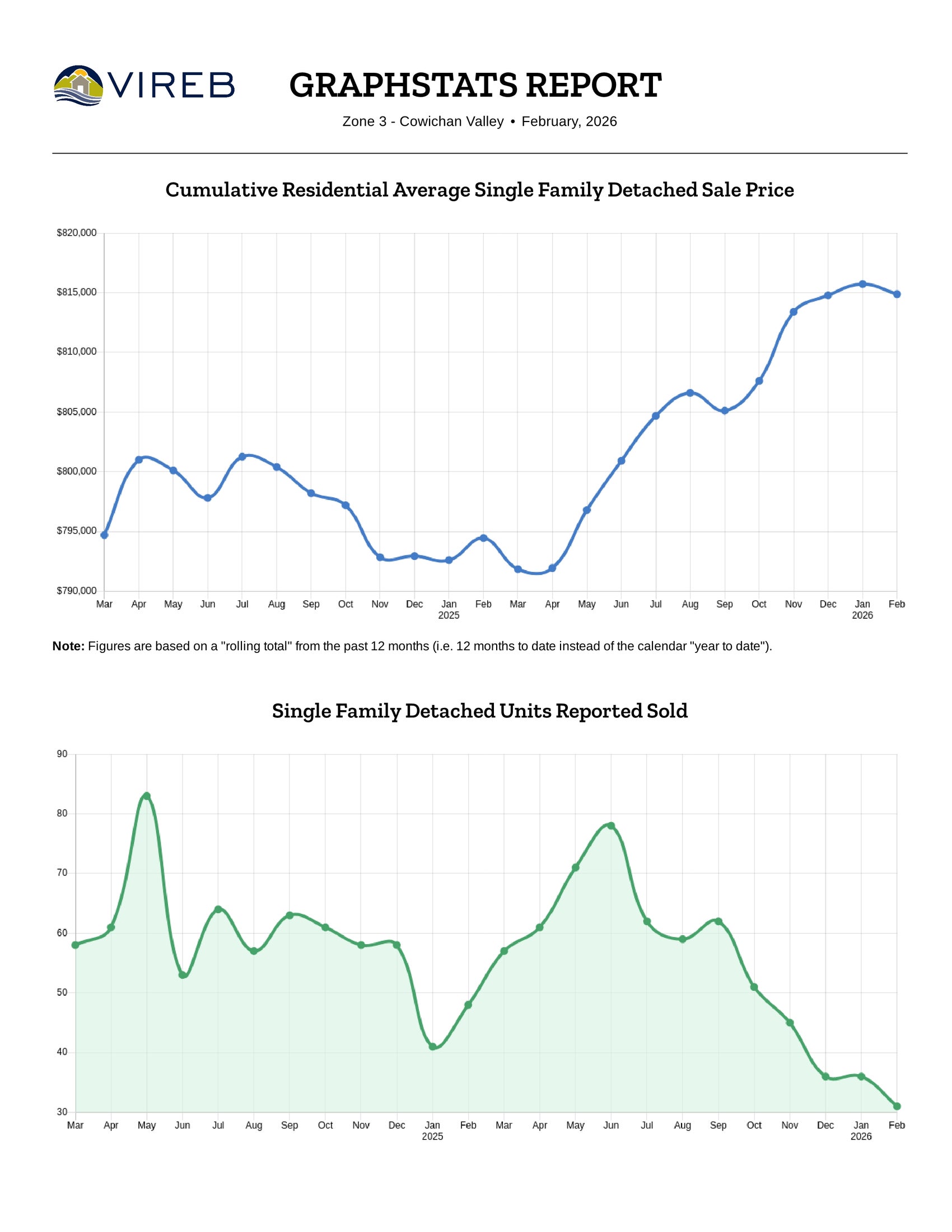
Summary: As of February 2026, the average sale price for single-family homes was $819,866, with a sell-to-list ratio of just under 97.2%.
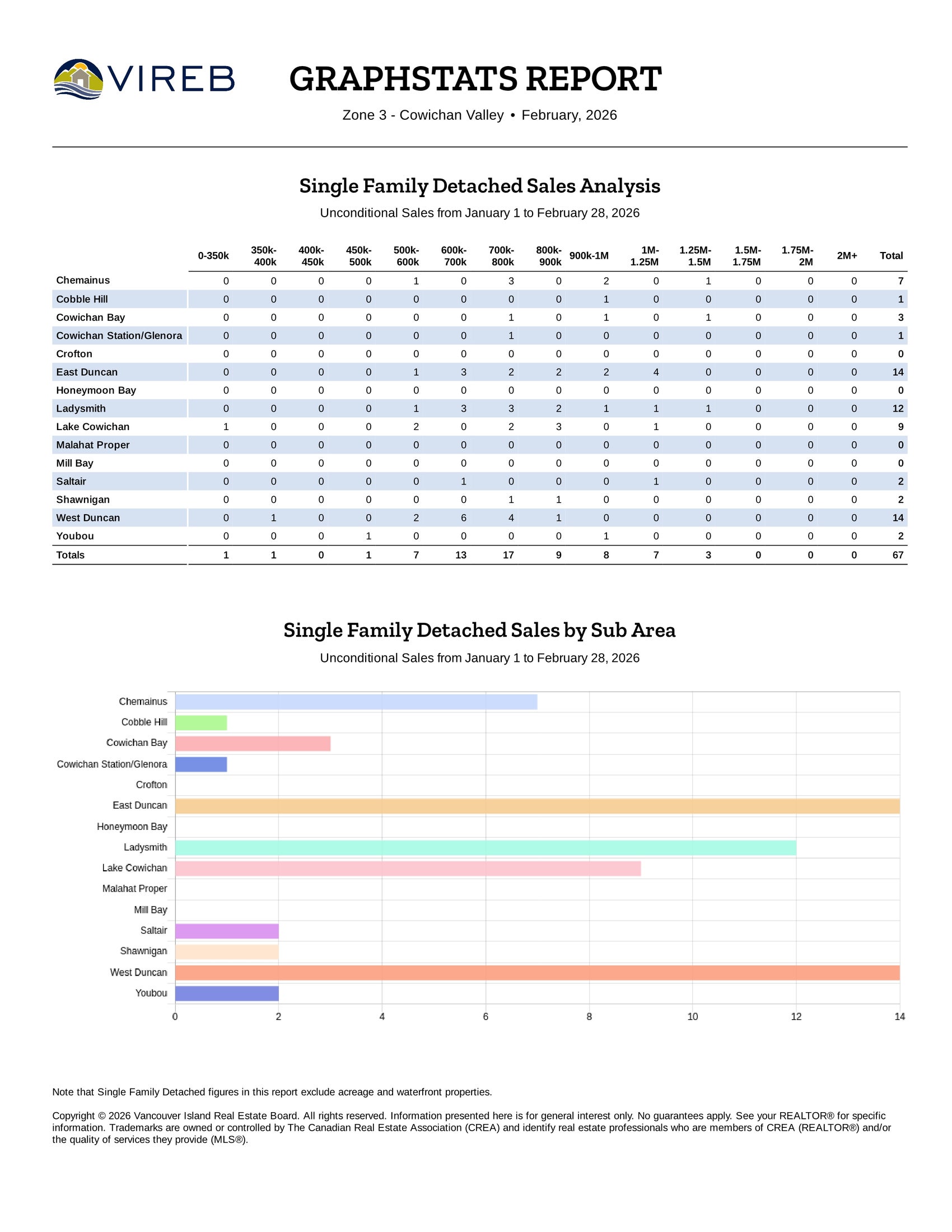
Sales Activity: A total of 31 single-family homes were sold in the Cowichan Valley during February 2026, marking a notable decrease from 48 homes sold in February 2025 and no change from 36 homes in January 2026.
Listings & Inventory: The market saw 79 new single-family home listings in February 2026, up 8.2% compared to 73 listings in February of last year. As of the end of February 2026, 208 homes were actively listed, up just 2 from 206 homes available at the same time last year.
Pricing Trends:
• The average sale price in February 2026 was $819,866, reflecting an increase from February 2025’s average of $829,822.
• Compared to January 2026’s average of $787,875, prices have strengthened slightly.
• For the 12-month period ending in February 2026, the median sale price stood at $790,000.
Annual Performance: Over the past 12 months, 649 single-family homes were sold, which represents a 7.9% decline compared to the 705 sales in the same period ending in February 2025. Despite the slower pace of sales, the average selling price for the year is up by 2.57%.
Market Supply & Days on Market:
• The supply of homes increased to 6.5 months in February 2026, up a bit from 4.7 months in February 2025.
• Homes sold in February 2026 took an average of 40 days to sell, compared to 64 days in February last year.
Condominiums
In February, the condominium market saw 5 units sold, down from 6 in January 2026. Sales are down from the 6 units sold in February of last year. The average price for condo apartments over the past 12 months ending in February 2026 rose to $348,868 - a 0.15% increase from last year's average of $348,357.
Townhomes
The townhome market experienced an downward trend, with 10 sales in February, a decrease from both the 14 units sold in January 2026 and 14 in February 2025 (a 28.6% year-over-year decrease). The average price for townhomes over the past 12 months ending in February reached $569,057, up 1.73% from $559,396 during the same period last year.
VICTORIA
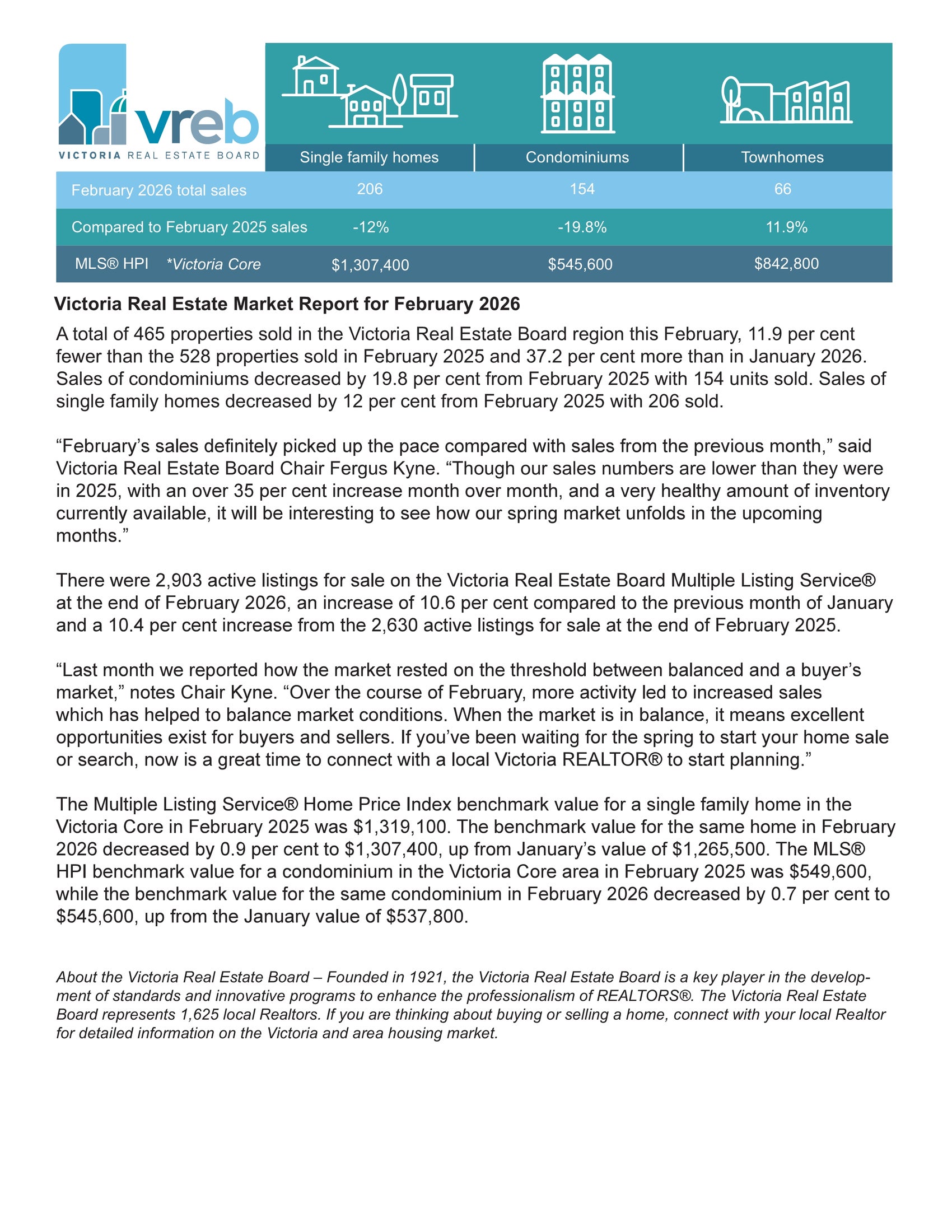
Summary: In February 2026, the benchmark price for single-family homes in the Victoria Core reached $1,307,400, reflecting a 0.9% month over month decrease from January 2026.



Summary: As of February 2026, the average sale price for single-family homes was $819,866, with a sell-to-list ratio of just under 97.2%.
Sales Activity: A total of 31 single-family homes were sold in the Cowichan Valley during February 2026, marking a notable decrease from 48 homes sold in February 2025 and no change from 36 homes in January 2026.
Listings & Inventory: The market saw 79 new single-family home listings in February 2026, up 8.2% compared to 73 listings in February of last year. As of the end of February 2026, 208 homes were actively listed, up just 2 from 206 homes available at the same time last year.
Pricing Trends:
• The average sale price in February 2026 was $819,866, reflecting an increase from February 2025’s average of $829,822.
• Compared to January 2026’s average of $787,875, prices have strengthened slightly.
• For the 12-month period ending in February 2026, the median sale price stood at $790,000.
Annual Performance: Over the past 12 months, 649 single-family homes were sold, which represents a 7.9% decline compared to the 705 sales in the same period ending in February 2025. Despite the slower pace of sales, the average selling price for the year is up by 2.57%.
Market Supply & Days on Market:
• The supply of homes increased to 6.5 months in February 2026, up a bit from 4.7 months in February 2025.
• Homes sold in February 2026 took an average of 40 days to sell, compared to 64 days in February last year.
This summary highlights the key market trends and performance for single-family homes in the Cowichan Valley, helping homeowners and buyers stay informed about the latest developments. Feel free to reach out for further details or if you need personalized advice!
Condo & Townhome Market Update
Condominiums
In February, the condominium market saw 5 units sold, down from 6 in January 2026. Sales are down from the 6 units sold in February of last year. The average price for condo apartments over the past 12 months ending in February 2026 rose to $348,868 - a 0.15% increase from last year's average of $348,357.
Townhomes
The townhome market experienced an downward trend, with 10 sales in February, a decrease from both the 14 units sold in January 2026 and 14 in February 2025 (a 28.6% year-over-year decrease). The average price for townhomes over the past 12 months ending in February reached $569,057, up 1.73% from $559,396 during the same period last year.
VICTORIA
Summary: In February 2026, the benchmark price for single-family homes in the Victoria Core reached $1,307,400, reflecting a 0.9% month over month decrease from January 2026.
Canadian Home Sales Begin 2026 on Ice as Snow Buries Central Canada
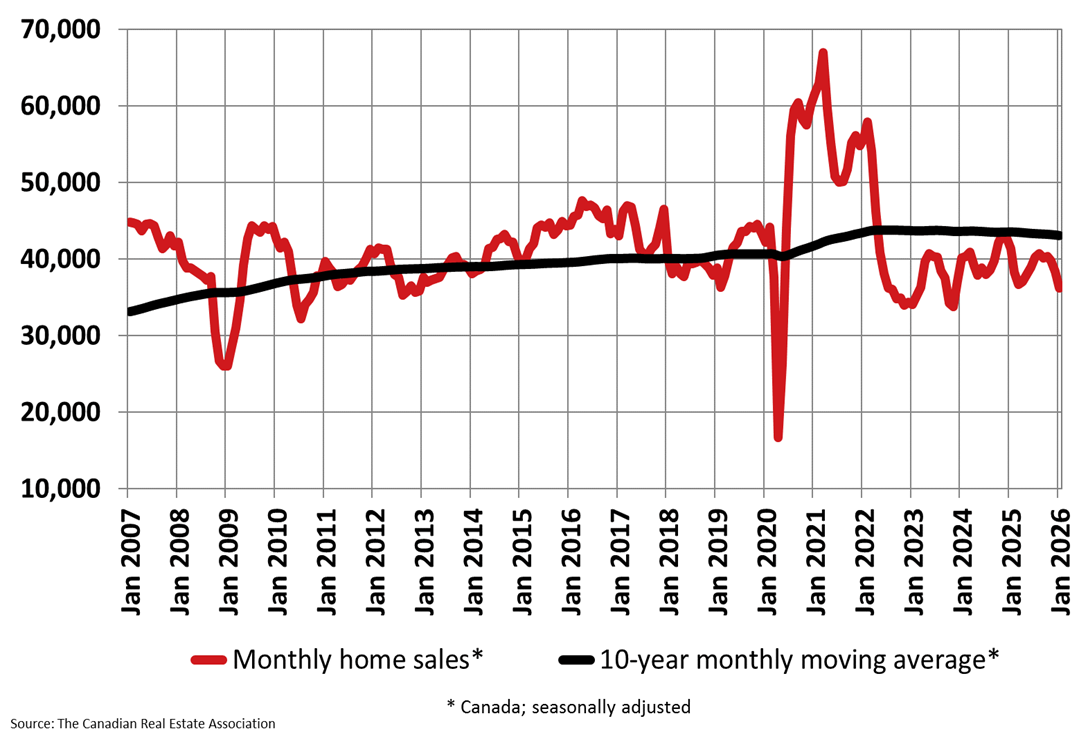
Ottawa, ON February 18, 2026 – The number of home sales recorded over Canadian MLS® Systems fell 5.8% on a month-over-month basis in January 2026. (Chart A)
“The monthly decline in national home sales was driven primarily by less activity in the Greater Golden Horseshoe and Southwestern Ontario, suggesting that the story was probably more about a historic winter storm than a downshift in demand,” said Shaun Cathcart, CREA’s Senior Economist. “Notwithstanding the chilly start to the year, we continue to expect 2026 will ultimately be defined by pent-up demand from first-time buyers finally seeing a chance to enter the market.”
January Highlights:
National home sales declined 5.8% month-over-month.
Actual (not seasonally adjusted) monthly activity came in 16.2% below January 2025.
The number of newly listed properties jumped 7.3% on a month-over-month basis.
The MLS® Home Price Index (HPI) fell 0.9% month-over-month and was down 4.9% on a year-over-year basis.
The actual (not seasonally adjusted) national average sale price dipped 2.6% on a year-over-year basis in January 2026.
Chart of interest A
Similar to what happened in January 2025, new supply jumped on a month-over-month basis in January 2026, rising 7.3% as sellers seemed eager to get the year started.
The burst of new supply was driven by about two-thirds of local markets, and led by Montreal, Quebec City, Calgary, Greater Vancouver, and Victoria. Meanwhile, Central and Southwestern Ontario were far less prominent and, in many cases, recorded declines. This reinforces the view that winter weather was a primary factor in January in those regions, as it appears to have suppressed both demand and supply.
“We always say all real estate is local, and on occasion, including this January, that can mean the impact of local weather on the market,” said Valérie Paquin, CREA Chair. “In a repeat of 2025, new listings are showing up early to start the year, so sellers are eager to getting going, but we may have to wait a bit longer to see how buyers react. There’s still plenty of time to get ready to buy or sell this year, and you can get started by contacting a local REALTOR®.”
With a rare combination of a sizeable increase in new listings and a sharp slowdown in sales in January, the national sales-to-new listings ratio dropped to 45% compared to 51.3% at the end of 2025. The long-term average for the national sales-to-new listings ratio is 54.8%, with readings roughly between 45% and 65% generally consistent with balanced housing market conditions.
There were 140,680 properties listed for sale on all Canadian MLS® Systems at the end of January 2026, up 4.5% from a year earlier but 11.4% below the long-term average for that time of year.
There were 4.9 months of inventory on a national basis at the end of January 2026, up from 4.6 months at the end of December. The long-term average for this measure of market balance is five months of inventory. Based on one standard deviation above and below that long-term average, a seller’s market would be below 3.6 months, and a buyer’s market would be above 6.4 months.
In line with more supply and less demand in January 2026, the National Composite MLS® Home Price Index (HPI) fell by 0.9% on a month-over-month basis.
The non-seasonally adjusted National Composite MLS® HPI was down 4.9% compared to January 2025. (Chart B)
Chart of interest B
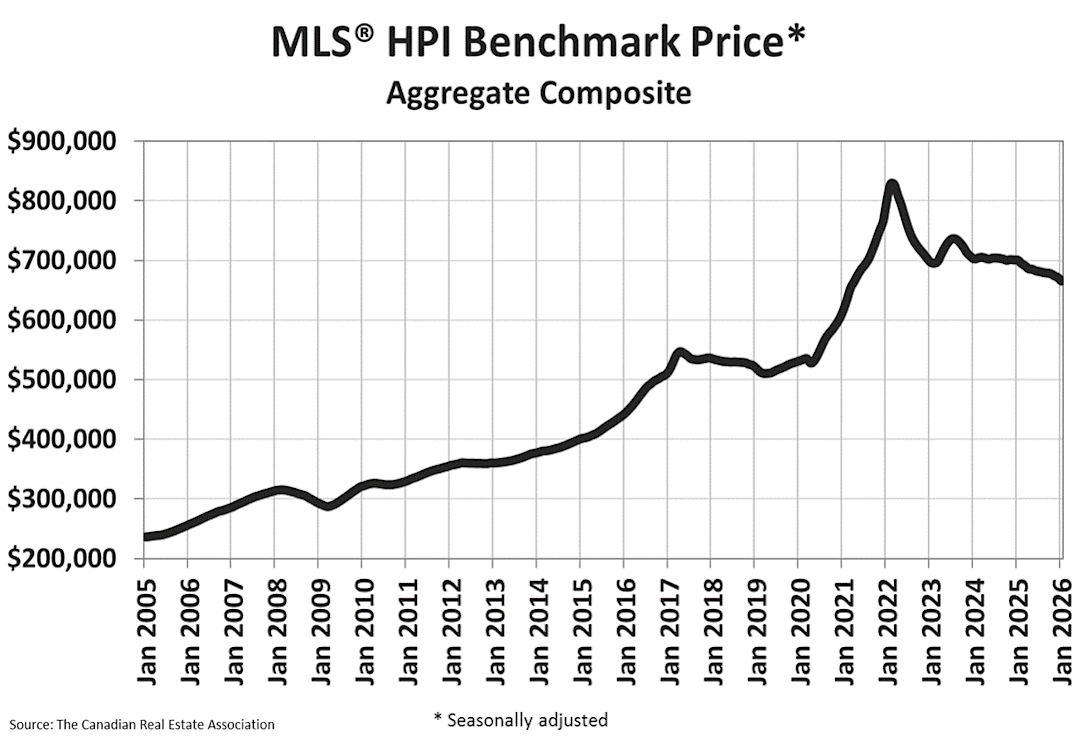
Regionally, prices remain down on a year-over-year basis in British Columbia, Alberta, and Ontario, offsetting gains in other provinces. An analysis by city shows the largest year-over-year declines dipping into double digits in Hamilton-Burlington and Oakville-Milton, contrasted by double-digit gains recorded in Sudbury, Quebec City, and St. John’s, Newfoundland.
The non-seasonally adjusted national average home price was $652,941 in January 2026, dipping 2.6% below the same time in 2025.
The next CREA statistics package will be published on Tuesday, March 17, 2026.
“The monthly decline in national home sales was driven primarily by less activity in the Greater Golden Horseshoe and Southwestern Ontario, suggesting that the story was probably more about a historic winter storm than a downshift in demand,” said Shaun Cathcart, CREA’s Senior Economist. “Notwithstanding the chilly start to the year, we continue to expect 2026 will ultimately be defined by pent-up demand from first-time buyers finally seeing a chance to enter the market.”
January Highlights:
National home sales declined 5.8% month-over-month.
Actual (not seasonally adjusted) monthly activity came in 16.2% below January 2025.
The number of newly listed properties jumped 7.3% on a month-over-month basis.
The MLS® Home Price Index (HPI) fell 0.9% month-over-month and was down 4.9% on a year-over-year basis.
The actual (not seasonally adjusted) national average sale price dipped 2.6% on a year-over-year basis in January 2026.
Chart of interest A
Similar to what happened in January 2025, new supply jumped on a month-over-month basis in January 2026, rising 7.3% as sellers seemed eager to get the year started.
The burst of new supply was driven by about two-thirds of local markets, and led by Montreal, Quebec City, Calgary, Greater Vancouver, and Victoria. Meanwhile, Central and Southwestern Ontario were far less prominent and, in many cases, recorded declines. This reinforces the view that winter weather was a primary factor in January in those regions, as it appears to have suppressed both demand and supply.
“We always say all real estate is local, and on occasion, including this January, that can mean the impact of local weather on the market,” said Valérie Paquin, CREA Chair. “In a repeat of 2025, new listings are showing up early to start the year, so sellers are eager to getting going, but we may have to wait a bit longer to see how buyers react. There’s still plenty of time to get ready to buy or sell this year, and you can get started by contacting a local REALTOR®.”
With a rare combination of a sizeable increase in new listings and a sharp slowdown in sales in January, the national sales-to-new listings ratio dropped to 45% compared to 51.3% at the end of 2025. The long-term average for the national sales-to-new listings ratio is 54.8%, with readings roughly between 45% and 65% generally consistent with balanced housing market conditions.
There were 140,680 properties listed for sale on all Canadian MLS® Systems at the end of January 2026, up 4.5% from a year earlier but 11.4% below the long-term average for that time of year.
There were 4.9 months of inventory on a national basis at the end of January 2026, up from 4.6 months at the end of December. The long-term average for this measure of market balance is five months of inventory. Based on one standard deviation above and below that long-term average, a seller’s market would be below 3.6 months, and a buyer’s market would be above 6.4 months.
In line with more supply and less demand in January 2026, the National Composite MLS® Home Price Index (HPI) fell by 0.9% on a month-over-month basis.
The non-seasonally adjusted National Composite MLS® HPI was down 4.9% compared to January 2025. (Chart B)
Chart of interest B
Regionally, prices remain down on a year-over-year basis in British Columbia, Alberta, and Ontario, offsetting gains in other provinces. An analysis by city shows the largest year-over-year declines dipping into double digits in Hamilton-Burlington and Oakville-Milton, contrasted by double-digit gains recorded in Sudbury, Quebec City, and St. John’s, Newfoundland.
The non-seasonally adjusted national average home price was $652,941 in January 2026, dipping 2.6% below the same time in 2025.
The next CREA statistics package will be published on Tuesday, March 17, 2026.